

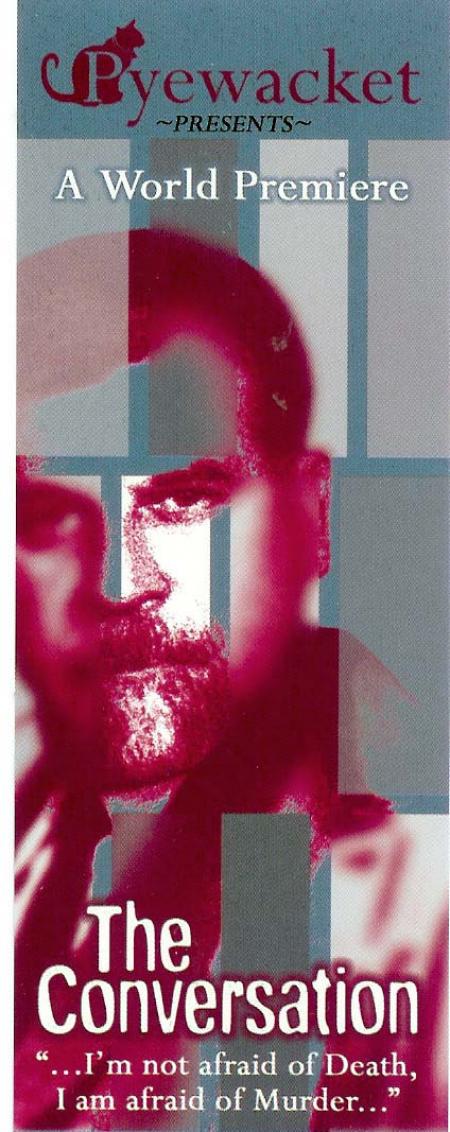
The Conversation
Pyewacket Theater
“World Premiere”
Highly Recommended – Chicago Sun Times
Highly Recommended – Chicago Reader
The Conversation went on to a New York run at 29th Street Rep Theater

“The Conversation” opened Off Broadway in 2008 after it’s World Premiere in Chicago at Chopin Theatre in 2005.
New York Times Review 04/23/08 – “There’s a big hole at the center of Francis Ford Coppola’s classic 1974 paranoid thriller, “The Conversation,” and his name is Harry Caul. So afraid of having his personal life invaded, this surveillance specialist, played by Gene Hackman, has few friends and refuses to answer questions about himself. Pauline Kael once described him as “a cipher in torment.”
It’s easy to see why Kate Harris would adapt the story of Mr. Caul’s awakening conscience for the stage: its theme of diminishing privacy remains relevant, and the screenplay’s tight structure, using very few scenes, translates well to the theater. But while the play remains fairly faithful, Ms. Harris can’t help filling in the blank slate of Mr. Caul (David Mogentale), including a monologue that describes a sickly youth who had a difficult relationship with his father.
By putting Mr. Caul on the psychiatrist’s couch, the story shrinks. The emptiness at the heart of this character is essential to the tragedy. And the tension of his trying to scrub his life clean while it keeps dirtying itself is the central drama.
Missing this point is typical of the sloppiness of Leo Farley’s production, which features uneven costumes (some look as if they are from the ’70s; others don’t) and continuity problems. Mr. Caul goes to sleep in his underwear at the end of Act 1 and then appears groggy and fully clothed in Act 2.
On the night that I saw the show, the cast members, especially those in minor roles, like Mr. Caul’s on-the-make rival William P. Moran (Tim Corcoran), seemed a bit flat. But Mr. Mogentale, who has a history of larger-than-life roles — Jack Henry Abbott and the title character in “Killer Joe” — nicely underplays Mr. Caul. He blends into the scenery, which has a spareness surely meant to emphasize the protagonist’s streamlined life.
Still, you can’t help thinking that an opportunity was missed with the small bookcase used to represent Mr. Caul’s apartment, which he famously destroys in the film’s final scene while in pursuit of a surveillance device. It’s easy to imagine finishing the play with a climactic disaster out of a Sam Shepard drama. Instead the stage just looks untidy” – Jason Zinoman, New York Times 04/23/08
“The Conversation” is playing through May 4 at 29th Street Rep, 212 West 29th Street, Chelsea; (212) 868-4444 or 29thstreetrep.com.
” Fans of “The Conversation,” Francis Ford Coppola’s strange, sinister, deeply disturbing, eerily prescient 1974 film, might have been more than a little worried when they heard that Pyewacket Theatre had decided to create a stage adaptation of the work. After all, why meddle with such a memorable cinematic gem?
As it turns out, the worriers can rest easy. Adapter Kate Harris, in collaboration with director Kenneth Lee, a terrific cast and a collection of savvy designers — led, most crucially, by that brilliant maestro of sound Joseph Fosco — have devised an altogether haunted and haunting production that is at once utterly faithful to the movie and creepily riveting on its own terms.
Coppola, who granted Pyewacket the rights to his work on the basis of Harris’ script, sent the company a good-luck e-mail prior to opening. His faith in the project (which follows on the heels of the company’s huge success last season with “Misery,” the Stephen King novel-turned-movie) has not been misplaced.
“The Conversation” was Coppola’s variation on two earlier classics: “1984,” George Orwell’s cautionary tale about Big Brother and the corrupting power of an all-knowing, all-controlling political regime, and “Rear Window,” Alfred Hitchcock’s tale of an impotent (metaphorically) photographer who doesn’t really see the full picture.
In his film, Coppola updated the technology to match an increasingly bugged, electronically wired society (and one just on the brink of computerization). And he directed Gene Hackman in a chilling performance as Harry Caul, the troubled, guilt-ridden, middle-aged loner and master in the art and science of surveillance — an expert who hires himself out to both government agencies and private clients, and who ends up very much like a character in a tale by Kafka as the victim of his own pursuits.
When we first see him, Caul (Robert Skrocki in a superb, utterly convincing performance) is working on a case that involves his taping of a young couple, Ann (Aasne Vigesaa) and Mark (Steve Best), who meet for a daily walk in San Francisco’s busy Union Square. Such moving targets are a test of his skill, and he has managed to get a very large percentage of their conversation recorded. Precisely what it reveals, and the consequences of what he has captured on tape, are difficult to tell.
More menacing still is the fact that when he delivers the tapes and collects payment for his work, he is stonewalled by an assistant (Mark Hicks) while the actual client, Mr. C (Ron Quade), refuses to see him. Ironically, while Caul spies on others he is obsessively hermetic about his own life. If there is a perfect metaphor for his existence, it is the fact that he lives alone in a tiny apartment and plays the saxophone accompanied by Music Minus One recordings.
Caul has a girlfriend, Amy (Joan McClive, deeply moving in her big scene with Harry) — a woman much younger than he, whom he visits from time to time and helps “support” financially. But he is unwilling to share a single bit of personal information with her. And when his usual discretion slips a bit at a convention for surveillance experts (there is marvelously competitive and sexually smarmy byplay here), he pays the price.
He’s betrayed by his nerdy assistant Stan (nicely ambivalent work by Doug Long), his rivals (first-rate character turns by Quade and Fred Husar), a pair of good-time girls (a brilliant, complex portrayal by Harris that goes far beyond the stereotype, and fine comic relief from Margaret Katch as the ditz) or some or all of the above.
Mood is of the essence here, and Lee and his actors have captured the hidden, guilty, nervous, vaguely paranoid aspect of all these characters’ lives in what is a very adult story. Scenic designer J. Branson’s solution for conjuring dozens of settings — Japanese-style screens that slide in and out of place — not only creates a world of movable, vaguely transparent walls, partial views and unstable situations, but it also pays homage to the cinematic origins of this work. Jared Moore’s wonderfully shadowy lighting and Jennifer Zielinski’s polyester-perfect costumes add to the effect.
But “The Conversation” is, first and foremost, a work about the aural environment. Sound is crucial to content, and Fosco has done a bravura job of weaving in every possible sort of cue — from reel-to-reel replay to traffic sounds and toilet flushes. The noise of the streets and the noise of the psyche play in perfect counterpoint. Arriving 30 years after the film, this stage version still projects all the same fractured chatter and emotional terror. No need to update the technology when the story is so of the moment. Hedy Weiss, Chicago Sun Times 1/28/05
“Francis Ford Coppola’s 1974 film, about a wiretapper enduring a personal crisis, appears an unlikely candidate for transfer to the stage. The tight montage and brilliant sound design in particular would seem difficult to re-create in a live production. Yet Pyewacket does a great job of finding stage equivalents for Coppola’s cinematic effects. Adapter Kate Harris and director Kenneth Lee play scenes over and over, just as Coppola reruns footage again and again to indicate his protagonist’s growing obsession with one of his surveillance subjects. And Joseph Fosco’s clever sound design conveys as well as the film does the process–including the pitfalls–of assembling a coherent “overheard” conversation from multiple hidden-microphone recordings. The play really belongs to Robert Skrocki, however, who conveys the inner turmoil of the protagonist, Harry Caul, nearly as well as Gene Hackman” – Jack Helbig, Chicago Reader 1/27/05
“Francis Ford Coppola’s 1974 film “The Conversation” about a surveillance expert embroiled in danger was the perfect cinematic response for a year in which a bug-happy American president was brought low by his own scheming and paranoia.
The story still resonates in post-Patriot Act America. Wisely, Kate Harris’ adaptation for Pyewacket doesn’t attempt to update Coppola’s story. She and director Kenneth Lee use some of the best conceits of the film while creating a three-dimensional theatrical experience, and the result is a frequently gripping and sad portrait of urban anomie and moral equivocation.
As Harry Caul, Robert Skrocki has the unenviable task of stepping into Gene Hackman’s shoes, but he does so with an air of stodgy austerity that hints at deep torment. In one of the strongest scenes, he runs out on his young adoring girlfriend (Joan McClive) when she begs him to tell her something about his life. As his surname suggests, Harry is wrapped in an isolating membrane, and he lives in painful denial of what his occupation has done to his ethical core. Joseph Fosco’s clever sound design re-creates the aural suspense of the film, while J. Branson’s set picks up on the voyeuristic theme by using a series of sliding semi-opaque screens, and Jared Moore’s lighting captures the empty coldness of Harry’s apartment and studio with chilly precision. Some of the performances were a bit wobbly on opening night, but Harris is terrific as a seductress, and Skrocki’s Harry is fascinating — equally sympathetic and repulsive” – Kerry Reid, Chicago Tribune 1/28/05
Director
Kenneth LeePerformers
Robert Skrocki, Kate Harris, Doug Long, Mark Hicks, Aasne Vigesaa, Steve Best, Ron Quade, Joan McClive, Fred Husar,