

Twilight: Los Angeles 1992
The Other Theater
Debut – The Other Theater in Chicago
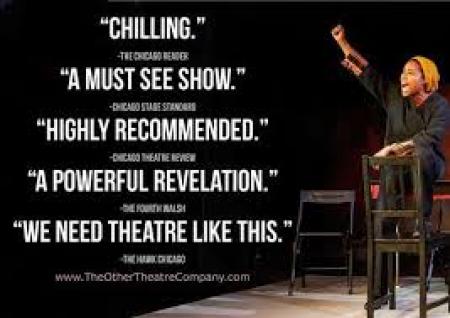
“This is a must-see show for people haunted by the fact that we live in a “morally tone-deaf society” and for lovers of good theatre alike.And despite all the grimness and ache, there is a glimmer of hope: TOTC is now here to challenge us with the questions that refuse to go away.“- Chicago Stage Standard
“We need theater like this. …is more than poignant, it’s vital. A must see, not just for the excellent work put in, but for the passion and fervor it ignites”–The Hawk Chicago
“From every angle, Gerace orchestrates honest storytelling from his sublime cast.” – TheFourthWalsh.com


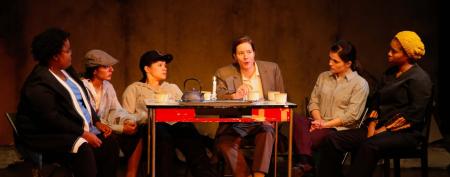
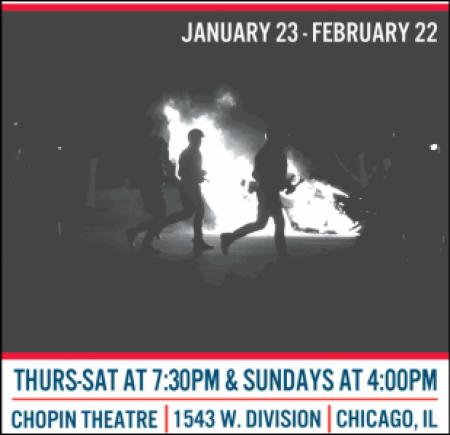
BLAZING “TWILIGHT: LOS ANGELES, 1992” – Hector Pascual Alvarez, ChicagoStageStandard.com – “…Rodney King.Eric Garner.Michael Brown…A riveting paradox.Theater deals with change. Its object of study is transformation. Yet, after watching The Other Theater Company’s production of Twilight: Los Angeles, 1992 you walk away crushed by the knowledge that nothing has changed in this country since… well, since when, really? Since Rodney King was brutally beaten by four LA police officers who were later acquitted? Since the days when trees in the South were strung with Spanish moss and the bodies of lynched black men?I imagine that for most people going to the Chopin Theater to see Anna Deavere Smith’s sharply wrought meditation on race, violence and justice this knowledge will not be news. But after seeing this show you know the truth differently. (L to R) Danielle Pinnock, Leena Kurishingal, Tanya Thai McBride, Mary Winn Heider, Carloyn Malloy, and Toya Turner. Photo credits: Carin SilkaitisCommitted to telling stories of individuals or groups who are “othered” or marginalized in society, The Other Theater Company is making an impressive entrance in the Chicago theater scene. Artistic director Carin Silkaitis (who did not direct the show but is one of the company’s founding members) and her team have chosen a timely and fascinating inaugural text. Twilight is based on interviews that Anna Deavere Smith conducted with some of the major characters connected to the Rodney King story as well as members of the communities that were engulfed by the violent riots that followed the trial (Smith’s intelligence and compassion allow her to portray the multi-layered picture of race relations in the US; rather than reducing issues to a black and white dichotomy, which a lesser playwright would have done, or to the kind of screechy self-righteousness that plagues a lot of political theater, she smartly weaves in stories from the Latino and the Korean communities that contest and add moral nuance to the major narratives of America’s racial history. This complicates things a lot; it also makes for riveting theater). The play was originally conceived as a one-woman show in which Smith embodied more than 30 different characters. Just like great poetry creates new ways of reading, Smith’s theatrical idiom creates new ways of watching theater. Fragmentation is very much the form that holds the play’s content: each monologue adds one more shard to the picture of a broken society. There is no linear development; rather, the juxtaposition of these fragments enacts a fierce dialectic that never quite resolves in synthesis. And since I’m throwing big words out there I’ll point out how Smith marries a “method acting” approach to character with a wider Brechtian self-awareness (transforming into a male Korean shop owner one moment, into Slow Food prophet Alice Waters the next, unmasks the larger social performances of race and gender in our every day life). The friction between these two styles results in a show that is both an intellectual and an emotional juggernaut.In The Other Theater Company’s version of Twilight, the 30+ roles are divided among a multicultural cast of six actresses. This is a smart choice because it amplifies that contradiction between stasis and transformation that I mentioned at the beginning. On the one hand, each actress is protean in their ability to change skin, diction and physicality. On the other, all these multiple transformations ironically reveal the common and unchanging humanity we all share. It also allows for a scene towards the end when six characters speak their monologues while drinking tea seated together at a table. The conceit works well. It’s not quite a dialogue but the broken shards are momentarily brought together.Jason Gerace’s staging has the energy of a raging fire. It is as furious as it is illuminating. At times, things do get disorienting, but of course so are riots. Yet, I wish that the delivery of each character’s name and profession was done less hurriedly.The unobtrusive and grungy set that Lizzie Bracken has designed captures the urban landscape of a city after the fire. And the choice of a thrust stage results in an intimate space where the cast shines as a generous and well-oiled ensemble.Mary Winn Heider makes fine work of Cornell West’s erudite and moving reflections on the black predicament. Toya Turner gives the young male Black Panther she portrays at one point the right amount of anger, while Carolyn Molloy makes your hair stand on end in the powerful closing moments of Act I. For her part, Tanya Thai McBride combines great comic timing with the very sadness that permeates Blues music. Leena Kurishingal struggles a bit with some of the accents but is entirely convincing (and moving) as Elvira, the pregnant woman who was shot during the unrest. Lastly, the über-charismatic Danielle Pinnock plays every part with gusto, but is particularly memorable as Maria, one of the jurors in the Rodney King trial. Watching her go up and down the emotional scale with such ease and precision I kept imagining her as the star of her own one-woman show. I was pleased to read in her program bio that such a show will hit town at the end of February (see www.bodycourage.com for more information).This is a must see show for people haunted by the fact that we live in a “morally tone-deaf society” and for lovers of good theater alike. And despite all the grimness and ache, there is a glimmer of hope: The Other Theater Company is now here to challenge us with the questions that refuse to go away.Twilight: Los Angeles, 1992 runs at the Chopin Theater from January 23rd until February 22nd.”
Highly Recommended – Documented History as Theatre – Colin Douglas, ChicagoTheatreReview.com – “Following the unthinkably violent incidents that occurred in the aftermath of Rodney King’s sadistic beating in California, stage and television actress, professor and playwright Anna Deavere Smith composed and performed this Tony-nominated and Drama Desk Award-winning show. In her solo performance, the actress portrayed an array of multi-ethnic individuals of both genders, all of whom were tied to this brutal incident ironically in the City of Angels. Using their actual words, Ms. Smith presented “the devastating human impact of that event.”Prompted by the recent shooting of Michael Brown and the death of Eric Garner, Chicago’s newest Equity theatre company, under the artistic direction of Carin Silkaitis, chose Ms. Smith’s 1994 play for their premiere production. The Other Theatre Company identify themselves as artist activists who champion a belief to fight for equality through drama.Rather than present this play as a one-woman show, as it was originally performed, Ms. Silkaitis has chosen to cast her production with six talented actresses of various ethnicities. In doing so, director Jason Gerace is able to remove such influential determiners as gender and race from his production, allowing each character’s words to ring louder and truer. The result is a topical, eye-opening reminder that history is constantly repeating itself. Events from the past should never be forgotten or swept under the rug; it’s important that we continually revisit history because it informs and reminds us that we must always strive to improve the quality of life for everyone in our society.In 1992 four police officers, despite video evidence proving otherwise, were acquitted of sadistically beating African American Rodney King, following a high speed car chase. The effect of this court decision provoked what became known as the LA Riots, in which the public’s anger over continued prejudice and brutality inflicted by law enforcement officials resulted in violence. What’s important to acknowledge today is that the United States seems to have learned nothing; such travesties of justice unfortunately continue today, over twenty years later.Mr. Gerace has expertly kept his eye on his goal. He presents a beautifully paced, unified production, the whole of which is greater than the sum of its individual vignettes. His production swiftly and seamlessly moves between interviews. Blessed with a phenomenally talented cast helps Mr. Gerace in the execution of his mission. Danielle Pinnock is a standout portraying a variety of characters, among them Jewish police commissioner, Stanley Sheinbaum. As one of the most impressive cast members, Ms. Pinnock is the go-to actress for bringing humor to this production and, in all but one of her fine portrayals, she provides most of the laughs. Tanya Thai McBride, a notable actress at Adventure Stage, creates a number of excellent personages, her Korean character being one of the most memorable. Remembered for her superb portrayal of Miss Haversham and others in Strawdog’s incredible “Great Expectations,” Mary Winn Heider plays each of her varied roles with poise, strength and dignity, always bringing honesty and at least a modicum of humor to most of her portrayals. Lovely, versatile and extremely talented Carolyn Molloy, Toya Turner and Leena Kurishingal complete this extraordinarily talented ensemble.For many reasons, this unfortunate slice of history still resonates today. We continually hear about examples of prejudice and bigotry, often resulting in understandable outrage and violence. It’s important to never forget such instances of man’s inhumanity toward man, to acknowledge the mistakes made and to learn from them. The Other Theatre Company fills a niche by telling stories of the oppressed, the persecuted, the downtrodden…the “others” in society. They are to be admired, not only for their mission to educate audiences while entertaining them, but for the high quality of their first production. This “American masterpiece,” as Newsweek called Anna Deavere Smith’s play, was created from nine months of real-life interviews taken from hundreds of individuals. However, the power behind Jason Gerace’s stunning production comes across as one undeniable voice, one that needs to be heard by everyone”.
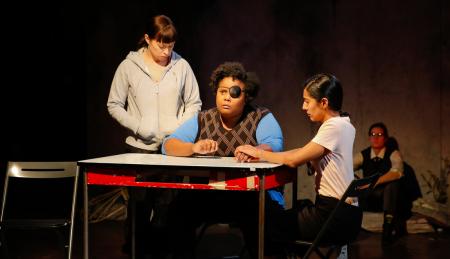
The Other Theatre Company makes its Chicago debut by presenting TWILIGHT: LOS ANGELES, 1992 to launch its inaugural season – Katy Walsh, TheFourthWalsh.com – “In 1992, four police officers were acquitted from brutally beating Rodney King. Los Angeles responded by inciting 6 days of rioting. Playwright Anna Deavere Smith captures the history and the humanity of the catastrophe. Smith interviewed various subjects in her “where were you during the LA riots?” retrospective. Smith then pieces together the compilation in a provocative montage. Her play doesn’t just have the anticipated perspectives of the televised exploited civil rights activists, jurors, police officers and victims. It also has the voices of the unknown stories of realtors, chefs, shopkeepers, and gang members. At Smith’s insistence, the stories are reenacted with all the actual pauses and stumbling over words of the recorded interviews. The results provide a powerful revelation and realization of the past and present dangers of hatred. Director Jason W. Gerace brilliantly chose an all-female and multi-ethnic cast. His talented ensemble skillfully morph into a variety of different characters. Their abilities to play male or female, black/white/latino or korean, and any age is not only impressive, it blurs the lines of prejudice. Knowing any spirit could be in any body is a theatrical and philosophical mind blower. Toya Turner, a black actress, embodies LA police chief Daryl Gates, a white man. The key jangling Turner explains how he (Gates) delayed his riot response because of a fundraising commitment. The monologue has plenty of authentic lunacy as Gates tries to justify his actions. Although Gates’ interview could have been reduced to well-deserved buffoonery, Turner sensitively portrays Gates as a proud and arrogant man that made a mistake. These snippets of life viewed in hindsight and a dozen years later are unforgettably disturbing. The outstanding Danielle Pinnock plays multiple distinct parts with comedic and dramatic perfection. Pinnock’s most memorable role is an effervescent LA realtor who is oblivious to the conflict from her Beverly Hills perch. All the actors continually make dramatic transformations. Tanya Thai McBride goes from a flamboyant black man to an uptight talent agent. One moment, Mary Winn Heider is a frightened juror and in the next she is a hardened revolutionary. Carolyn Molloy plays both an affected artist and an enthusiastic victim describing events with completely opposite deliveries. Among her roles, a noteworthy Leena Kurishingal tells the story of a young pregnant woman. From every angle, Gerace orchestrates honest storytelling from his sublime cast. I highly recommend everybody seeing TWILIGHT: LOS ANGELES, 1992. With the recent deaths of Michael Brown and Eric Garner, the act and response to racism continues to be violence. It’s apparent that we, the human race, are not learning from our past mistakes. We must continue to educate ourselves and see life from others‘ perspectives.”
Director
Jason GeracePerformers
Mary Winn Heider; Leena Kurishingal; Tanya Thai McBride; Carolyn Molloy; Danielle Pinnock and Toya Turner