


The Woyzeck Project – WOYZECK
The Hypocrites
The Woyzeck Project – a City wide festival celebrating this classic proletariat tale.
Showtimes: Fri 730p; Sat 7p; Sun 5p
Highly Recommended. “...blistering and altogether superb ..real yet stylized staging that is not only a thrilling take on Buchner’s classic, but an example of Graney working at the top of his powers” – Hedy Weiss, Chicago Suntimes 4/25/11
Four Stars; ” ..ferocious, feverish comedy” – John Beer,TimeOut Chicago 4/27/11
Tix $28 ($48 w/Pony by About Face Theatre) – 866.811.4111


The Woyzeck Project – a City wide festival celebrating this classic proletariat tale.
“Hypocrites launch Woyzeck Project with a bang” – Hedy Weiss, Chicago Suntimes 4/25/11. “Woyzeck,” the brief but riveting play left in fragmentary form when its German author, Georg Buchner, died of typhoid fever at the age of 23, has had an immense impact on all of modern art.
An almost ritualistic depiction of how a human being can be driven to the breaking point, Buchner’s drama (written in 1836, and first produced in 1913) not only became a cornerstone of the German Expressionist movement, but inspired a masterful opera by Alban Berg, several movies (including one by Werner Herzog), a song by Tom Waits and countless theatrical riffs.
Now, six Chicago theater companies have joined forces for the Woyzeck Project, a multifaceted exploration of Buchner’s provocative work. The two full-fledged productions that opened this weekend and will run in rotating repertory are adapter-director Sean Graney’s blistering and altogether superb take on the play for The Hypocrites, and About Face Theatre’s expertly actedproduction of “Pony,” Sylvan Oswald’s tale that primarily uses “Woyzeck” as an excuse for exploring extreme issues involving sexual identity. Both shows are on the mainstage of the Chopin Theatre, where they deftly share many elements of Tom Burch’s elemental set design, which comes with an enigmatic, “Twin Peaks”-like alienation factor.
Buchner’s story, at once primal and modern, tells of a young soldier who has fathered a baby with the beautiful but unreliable Marie, his common-law wife. Desperate to earn extra money, Woyzeck subjects himself to an experimental program testing the mental and physical effects of a long-term diet consisting only of peas. The deprivation of that diet, combined with dehumanzing relationships at work, and most crucially, with Marie’s infidelity, drive him to murder.
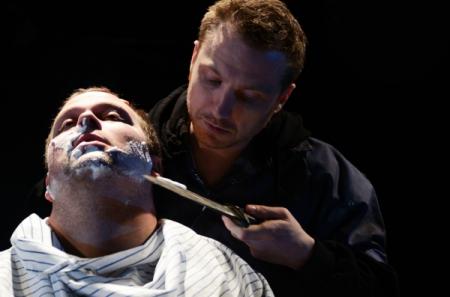
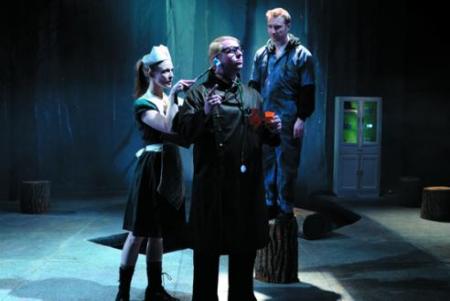
Graney, who has taken a Brechtian approach to the play — adding powerhouse songs by composer Kevin O’Donnell and a fascinating soundscape created by by Mikhail Fiksel and the actors — gives us a backdrop of army life and hazardous materials’ cleanup work. His Woyzeck (the ideal Geoff Button, boyish yet intense) is matched by the easy allure and fire of Marie (Lindsey Gavel, a tall, stunning, luminous-faced redhead). And for his searing, hourlong telling of the story, Graney also has tapped a terrific ensemble, with Ryan Bollettino as the narcissistic Herr Doktor; Sean Patrick Fawcett as the puffed-up, morals-spouting Captain; Erin Barlow as Kathe, Marie’s “friend”; Walter Briggs as Marie’s handsome, fascistic lover; Ryan Bourque as Woyzeck’s only friend, and Zeke Sulkes, ideally fey in several roles. Izumi Inaba’s deftly color-coded costumes are standouts in this real yet stylized staging that is not only a thrilling take on Buchner’s classic, but an example of Graney working at the top of his powers.
For her About Face production of “Pony,” director Bonnie Metzger also has gathered excellent actors who give their all to Oswald’s confusing look at an unsolved crime of passion and to the profound stresses that result from living any one of the many possible variations on non-heterosexual life. (A glossary of terms is included in the program.)
Set in a rural, Western town, “Pony” offers a Marie who in this case is bisexual (played by leggy, sexy Kristina Valada-Viars). She is being pursued by two people: Woyzeck’s equivalent, Pony (Kelli Simpkins), a lanky, cowboylike, unemployed “trans man” (a woman who identifies as a man), who subjects himself to psychological testing for pay at a clinic run by Cav (Janet Ulrich Brooks in old-school butch mode), and by Stell
(Jessica Hudson), a punk-grunge lesbian hot for cash and short on requited love.A subplot involves Heath (Matthew Sherbach), a city kid who is now (but wasn’t always) a nerdy gay boy.
The unseen crime of passion here remains fuzzily explained, at best. The rest of Oswald’s episodic play is primarily about sexual ambivalence of every sort , and the price of hiding oneself. “Pony” is no “Woyzeck.”
Note: In addition to these shows, the Woyzeck Project includes Oracle Productions’ take on Buchner’s play, directed by the excellent Max Truax, and extended through May 21 at its 3809 N. Broadway home (where you can pay what you wish or attend free); plus, many readings and discussions presented by Collaboraction, Route 66 Theatre Company, The Inconvenience and the very interesting Chicago Opera Vanguard.
For details, visit www.thewoyzeckproject.com”
Woyzeck – John Beer, TimeOut Chicago 4/27/11 – “Büchner, inconsiderately enough, died before completing his 1837 masterpiece of visionary angst, thereby leaving interpretive quandaries galore for generations to come. Graney’s exuberantly eccentric production layers Woyzeck with apparent distractions, including numerous German-language tags and a stuffed reindeer. That it also yields a bracing, inspiring performance may be a tribute above all to the capaciousness of Büchner’s haunting scenario.
Not surprisingly, Graney spotlights the comic aspects of Woyzeck’s plight—his fussily condescending commanding officer, the pea-obsessed Herr Doktor. But it’s a feverish comedy, as bits of ominous dialogue circulate repetitively around the stage and Woyzeck’s enormous knife makes frequent appearances. The ferocious violence of the play’s climax turns out to have been perfectly prepared by the piece’s Kubrickian opening: The performers come on in hazmat suits, as though the play itself is radioactive. With its coda, in which the risen Marie (Gavel) congratulates us for watching a “beautiful murder,” this fiercely inventive take suggests it just might be a little toxic”.
Woyzeck, Two Ways The Hypocrites and About Face Theatre play with Georg Büchner’s antihero. – Dan Weissman, Chicago Reader 4/29/11. “Avant-gardists have always been drawn to Woyzeck, and it’s easy to see why. For one thing, it was unfinished when its German author, Georg Büchner, died young of typhus in 1837. Some scenes look like fragments, some may’ve been rejects, and there’s no clear indication of their order, so an experimenter has plenty of room to mess around.
It’s also as dark as can be. Based on a sensational crime of the period, Woyzeck follows the unraveling of a soldier who, driven crazy by poverty and powerlessness, kills the mother of his infant child. The piece is full of biting social satire—with blackly comic, over-the-top scenes of powerful assholes abusing the hapless antihero—and constitutes a blueprint for pretty much all of Bertolt Brecht, parts of Waiting for Godot, and Monty Python at its nastiest.
This spring, six Chicago theaters and an opera company have banded together to present the Woyzeck Project, a festival anchored by two shows running now at the Chopin Theatre: About Face Theatre’s premiere production of Pony by Sylvan Oswald, which tosses a few Büchnerian elements into a contemporary story about transgender identity, and Woyzeck itself, as adapted and directed by Sean Graney for the Hypocrites. In addition to sharing a venue and a starting point, the two productions employ the same set, sound, lighting, and prop designers.
The Hypocrites give us Büchner’s story straight up. Franz Woyzeck hardly ever sees his lover, Marie, because he’s constantly working humiliating side jobs to supplement his military pay. One, as a subject in a science experiment, may actually be designed to drive him nuts, and he’s starting to experience nightmarish hallucinations. Eventually Marie takes up with another guy. When Woyzeck catches on, he leads her out to the woods and kills her. Graney’s adaptation steals text from various parts of the original to cobble together a narrator of sorts—a knowing, sinister figure who appears to Woyzeck at times, tipping him off to Marie’s infidelity and giving him confirmation, with a raised eyebrow, of his doom.
Graney and his crack ensemble tease out the play’s humor, pathos, and terror. Scenes in which Woyzeck is tormented by his bosses, Captain Hauptmann and the mad scientist called Herr Doktor, are played broadly and expertly for laughs. But, in a remarkable choice, Geoff Button is allowed to project kindness and intelligence as Woyzeck. From his first scene, he comes across as a grounded, decent, sweet guy who just happens to be losing his marbles.
The production design is similarly bold. In a brilliant stroke by sound designer Mikhail Fiksel, the cacophony in Woyzeck’s head—buzzing insects, a wheezing baby’s cry, the beating of his own heart—is produced by the other actors, who become a kind of choral, oral Foley artist. And everyday objects develop into powerful symbols: An oblong rock, for instance, represents Woyzeck and Marie’s baby—until it becomes a weapon.
Graney’s most potent image is a simple can of peas. Herr Doktor’s experiment requires Woyzeck to eat nothing but peas for months, and throughout the play, even as he listens to Marie’s dying sobs, Franz keeps spooning them into his mouth. It doesn’t occur to him to break the habit of obedience.
About Face’s Pony is similarly accomplished, with outstanding performances throughout. But Oswald’s play ultimately disappoints. The eponymous character is a woman who blows into town passing as a man. Pony takes up with Marie, who—in the play’s closest connection to Woyzeck—is obsessed with a recent crime of passion in the woods: Another woman named Marie was stabbed to death there by a jealous lover. Oswald’s Marie says she wants to know, to experience, the murderer’s state of mind. Everyone in the piece has cards they play close to the vest, mostly having to do with gender. But Marie’s obsession remains a mystery until the end, and then it doesn’t add up. Her craziness comes across as a stock device.
There are plenty of other problems. Late in the action, Pony acquires an annoying tendency to state the play’s themes in essay-like monologues. Another character, a therapist, takes a turn towards violence that doesn’t seem in tune with the person we’ve known to that point. And Marie apparently turns completely sane in the play’s last moments.
Oswald’s dialogue is smart, though, and the play offers a sweet scene between Pony and a young queer man, Heath, who’s come looking for her. Kelli Simpkins’s Pony and Matthew Sherbach’s Heath are absolutely endearing. Director Bonnie Metzgar gives the script’s every nuance time to breathe, for better and also for worse: If the pace were quicker, the holes in the script might be less noticeable”
2 takes on an 1837 classic drama are paired with mixed results – Nina Metz, Chicago Tribune 5/4/11
“This spring a handful of Chicago theater companies are staging various interpretations of “Woyzeck,” German playwright Georg Buchner’s unfinished but nonetheless influential 1837 drama about a man who buckles under the pressures of life.It’s never just one thing that sends a person over the edge, but money troubles will turn any grim situation into something much worse. This aspect in particular is highlighted in The Hypocrites’ production of “Woyzeck” (✭✭1/2) at the Chopin Theatre, adapted and directed by Sean Graney, whose strange and entertaining sense of style (the tone borrows ever so vaguely from “A Clockwork Orange”), theatrical impishness and fascination with the dark side of the human soul can’t quite solve the production’s problems.
The world crushes the poor, humble soldier Woyzeck (Geoff Button, appropriately pathetic) — at the hands of his military betters, the doctor running a cruel medical experiment designed to drive Woyzeck to insane and his common-law wife (a wonderfully enigmatic Lindsey Gavel) who cheats on her man but has no qualms about accepting his money.
Not to get all Ayn Rand up in here, but Woyzeck, for my taste, is just too easy to disdain, something that has always colored my feelings toward the play. That said, it’s good how Graney emphasizes the transactional nature of Woyzeck’s relationships: Every time cash is exchanged, the characters smack the bills with the backs of their fingers. It is a small but chilling detail that resonates during these economic times. No matter what, Woyzeck is doomed by external forces, and perhaps Buchner’s point, clunky as it is, is that we ignore the pain and troubles of others at our own peril.
Running in repertory at the Chopin is the entry from About Face Theatre called “Pony” (✭✭), playwright Sylvan Oswald’s modern-day story of transgendered identity that feels only tangentially linked to the Buchner original. There’s not much of a theatrical conversation going on between the two productions, other than a terrific shared set by Tom Burch that includes a water element and rough-hewn details.In director Bonnie Metzgar’s intriguingly grubby staging, a loner, Pony, (a riveting Kelli Simpkins) is the Woyzeck equivalent who becomes obsessed with an unstable flirt named Marie (Kristina Valada-Viars), a character whose delusions and true-crime obsessions are the play’s least interesting moments. The plot splits off in various directions and digressions — the portions featuring Janet Ulrich Brooks’ preppy-butch, no-nonsense social worker are mini-masterpieces of performance — but the disparate strands never quite come together”
Woyzeck – Highly Recommended, Chicagocritic.com – “A funny thing that an author’s most influential work should be incomplete at the time of his death; but such is the case with Woyzeck, by Georg Büchner, who died of typhus at only twenty-three. It is a powerful play by a young man who might have achieved the heights of Goethe and Schiller. Even as unfinished sketches, it strikes at the heart. And not only is it the first German play about a commoner, it is unflinching in its assessment of the German condition; of class boundaries and moral assumptions; in its sympathetic cruelty to the ordinary man.
The story is of a poor soldier in a small, German town, living with a girl, whom bore his child out of wedlock: marriage, after all, is expensive. He saves money however he can, performing menial jobs and taking part in medical experiments. His health begins failing, and the girl turns to another man. In a jealous rage, he kills her.
That is the broad outline, but the details are sketchier: there are several drafts of the play, with different endings, implications, and scene sequences. So each production of this play can be as unique as it likes, placing scenes where they will, choosing how mad Woyzeck is and which ending they prefer.
It is also a piece that influenced the Expressionists, seventy-some years later; and this detail is not lost on the Hypocrites, who have made Woyzeck a piece of Epic Theatre, of Theatre of the Absurd, Theatre of Cruelty. It is Bloc Theatre, exciting, odd, and gripping. The actors never leave the stage, sitting on tree stumps when not taking part in the action, creating sound effects, setting the ambience. The audience is aware of the artifice of theatre, of the play’s metatheatricality: certain words are linked to certain actions or other words spoken by those “off-stage.” The destruction of realism creates a new dichotomy, with the theatre more visceral and immediate, yet metaphorical and intellectualized. And Hypocrites realizes this aim very well. And the lighting, set, costumes, as well as the rest of the production enhance this goal.
I say very little because there is too much to say. This play is rich, its social commentary compelling, its presentation fulfilling. It deserves a treatise, rather than a review; and since that is something I cannot give it – I would feel yet unqualified after ten viewings, though I doubt the piece would get old even then – brevity seems to offend less. But let me say: in a city where the Kitchen Sink drama reigns supreme, where realism abounds and musicals thrive, this is refreshing, bold, and daring, and will leave you gloriously shocked as only something that presents dark truths so immediately can”
Woyzeck – Highly Recommended, Daniel Jakes/Chicago Theater Blog – “When Georg Büchner dropped
dead in 1837, he left behind a work-in-progress that has since been a powerful draw for artists and academics…and an even bigger pain in the neck for editors. The original script for Woyzeck–that’s an assumed title, by the way; Büchner never had the chance to choose one himself–was a scribbled hodgepodge of fragments and scenes chronicling a layman’s transformation into a killer written on unnumbered pages.
Performing the text as-is is not an option, at least not a compelling one. Producing this soldier story takes a heavy-hand, a willingness to make a directorial mark, and some serious cojones.
Enter Sean Graney.
The Hypocrites artistic director has developed a knack for bold theatre and ranks among the most exciting directors working in Chicago. Graney possesses the ability to unearth the hearts of classic texts and translate them to contemporary audiences by employing an arsenal of visceral elements. In this Woyzeck, he plays maestro–soundscapes, a dumb show, and music by Kevin O’Donnell help forward the plot and give body to heady expressionist ideas. His adaptation streamlines what Büchner left meandering. His rewrites, rearrangements, and omissions are always with clear
purpose and are always for the better.The title tragic hero, played by Geoff Button, is given the full Job treatment from his country, his colleagues and his wife. Subjected to inhumane medical experiments, degrading work conditions and an ungrateful spendthrift spouse, Woyzeck descends into desperation. His misery is amplified by the production’s wry, cruelly detached sense of humor–his child is literally presented as dead weight: a rock.
Visually, it’s captivating. Tom Burch’s set design juxtaposes nature with biohazard plastics in a vast and functional playing space. Dangerous elements get the richest, most appealing colors–appropriate for a show whose characters find beauty in destruction.
The Hyprocrites allow us to pity the tormented protagonist while alienating us just enough to objectively consider the morality of his and our resentment toward his adulteress wife (Lindsey Gavel). Added repetition in dialogue and gestures conveys the soldier’s ability to endure anguish for the people he loves, and suggests a breaking point may be the only solution for escaping the hellish loop of giving-without-return; suggests, but doesn’t dictate. The specific tragic end Graney chooses for his doomed young man leaves some questions open-ended. Unlike in Büchner’s text, they’re the right kind.
Woyzeck, Pony and the Working Class Tragedy – www.gapersblock.com. “About Face Theater and The Hypocrites began their “Woyzeck Project” this month, a city-wide festival celebrating the classic proletariat tale, Woyzeck– an avant-garde working-class tragedy, left unfinished by Georg Büchner upon his death in 1837.
The festival is anchored by About Face’s production of Pony and The Hypocrites’ world premier adaptation of Woyzeck. I caught both of them in a double feature of sorts last Sunday at Chopin Theater.
WoyzeckWoyzeck, Pony, and the Working-Class Tragedy – www.gapersblock.com.
“About Face Theater and The Hypocrites began their “Woyzeck Project” this month, a city-wide festival celebrating the classic proletariat tale, Woyzeck– an avant-garde working-class tragedy, left unfinished by Georg Büchner upon his death in 1837.
The festival is anchored by About Face’s production of Pony and The Hypocrites’ world premier adaptation of Woyzeck. I caught both of them in a double feature of sorts last Sunday at Chopin Theater.”
The first thing you will notice about Woyzeck, as with most plays, is the set. And this is a gorgeous set by Tom Burch. It is minimal in the sense that you can tell you’re outside, in the woods somewhere, but there are not trees and moss–not much, anyway. There is, however, a white deer, a collection of tree stumps, two cabinets and a brook/river–running with real water. The play opens gradually with a man in a hazmat suit and a respirator mopping up the stage around another figure, also in a hazmat suit, who is presumably dead. Behind a translucent sheet at the back of the stage, we see five more figures, also wearing respirators, but with no hazmat suits–only long underwear and combat boots. As the play begins, the figures quickly change costumes onstage while aggressively singing a powerful opening number. At this point it should be mentioned that this is, in a sense, a musical–in that there is singing. But make no mistake, this is not a musical in an traditional sense (or anything else in any traditional sense, for that matter).
The second major thing you will probably notice about Woyzeck is that the language is fragmented, to say the least–as if it were translated directly and literally from German, with all the awkward sentence structure that comes with that. The language is incredibly playful and poetic, too. Much like Shakespeare. And much like Shakespeare, you likely won’t understand every single sentence that hastily spills out, but you’ll get the gist of what’s going on.
Perhaps the most interesting thing about The Hypocrite’s Woyzeck is that every actor is onstage at all times, and if they’re not actively participating in dialogue at the center of the stage, they’re sitting off to the side making naturey sounds–coos, clicks, hums, whistles, etc. Key words from conversations are occasionally echoed by the “peanut gallery”, as well. The effect of this is both eerie and stimulating–suggesting a sense of collective consciousness, a “we are all one” sort of vibe. And/or (depending on your state of mind) a glimpse into the mind of a maniac with some sort of multiple personality issues.
Woyzeck is a classic tale of a love triangle, complete with a classic murder/suicide ending, but the execution is anything but classic. It is disconcertingly, brutally violent and epic and deliciously avant-garde. It is quite obviously the work of Sean Graney, and is possibly his best/darkest/weirdest production to date. Graney and The Hypocrites are an invaluable staple in Chicago’s experimental theater scene, now more than ever. If you only see one play in The Woyzeck Project, see this one.
Pony
From the moment I saw this play last Sunday up until now, I have been trying to figure out how Pony (written by Sylvan Oswald and directed by About Face Artistic Director, Bonnie Metzgar) is related to Woyzeck and why they’re being shown in tandem. There are few similarities other than their using (pretty much) the same set–except a lot of the cool stuff from Woyzeck’s set, like the deer, was taken off and replaced by far less interesting objects–and the “Marie” character in each play is in the midst of some sort of poly-amorous drama.
The Marie in Pony is a waitress who is obsessed with a murder that took place in the woods (the murder that ends Woyzeck), and she gets off on imagining herself as the characters of that murder–both murderer and murderee. So there’s that. But that aspect of Pony doesn’t really seem to mesh with the rest of the plot, and, frankly, adds a cheese factor to this play. Why is this crazy chick running around the woods with a broken mirror, screaming into it and constantly having some sort of panic attack? Rather than harp on the connection between Pony and Woyzeck any further, I will just consider Pony as an autonomous piece, addressing problems related to sexuality and identity.
It works better that way, but it still doesn’t work. Sure, it’s great that transgender issues are beginning to be addressed comprehensively via the arts (and the media, for that matter), but Pony is grouchy, too fragmented and asks a whole lot of questions without offering any real answers. And not in a thought-provoking, art-imitates-life kind of way. In a frustrating way. How did these characters get where they are now, and where are they going? What is our trans protagonist, Pony, running from exactly? What does he want? What the hell is Marie’s problem? Why is everyone so damn mean to each other?
And with that, I’ll leave you with a question: What’s the point?”
Tix $28 ($48 w/Woyzeck by The Hypocrites). 866-811-4111
Director
Sean GraneyPerformers
Geoff Button; Lyndsay Gavel; Sean Fawcett; Ryan Bollettino; Walter Briggs; Zeke Sulkes; Erin Barlow; Ryan Borque