



Miss Julie
The Hypocrites
Highly Recommended. Don’t Miss! – TimeOut Chicago 1/25/08
Highly Recommended – Chicago Reader 1/24/08
Jeff Recommended
5 Shows To See Now – New City


Highly Recommended – TimeOut Chicago . “If Miss Julie makes sense again, we might all be fucked.August Strindberg’s unpleasant 1888 overture to Naturalism with a capital N kicked open the door to the 20th century, and American theater and film in particular, when you consider how important “plainclothes tragedy” is to our literary tradition.
Yet for all the things Strindberg predicted and even made possible with Miss Julie, his cruelly misogynist text with the slaughtered animals and smutty Victorian S&M role play is a drama you don’t want to understand. But counterintuitively, this intellectually isolating work is perhaps the most emotionally accessible thing director Sean Graney has yet pulled off.
Strindberg wrote Miss Julie in reaction to what he viewed as a rapid acceleration of cultural and socioeconomic change. His lurid story is about a young aristocrat with a jones for rough trade; she manages to bed her father’s on-the-make footman and pays for it with her life. In its day, the mere suggestion of such a breakdown in social castes was both terrifying and kind of a turn-on, but, more important, it was one that proved accurate in the next century, when gypsy scum would become moguls and royalty would marry common folk.
Even if it fails to draw modern parallels, the Hypocrites’ new production—which is both fine theater and fine basement theater—still feels uncomfortably familiar. Although on its surface this unconventional staging might look just as rebellious as anything the punk troupe has ever shat upon, the production follows many of Strindberg’s radical preface instructions to a tee. Use the most intimate space possible, the playwright urged; treat the fourth wall like the dodo bird; forget about traditional lighting or you’ll never be able to see any facial expressions (all three actors are good, but lighting designer Jared Moore, diffusing a brilliant color palette, is the star); use live musicians, but stick them where they won’t obstruct our view. (Never one to give a writer complete domain, though, Graney still includes signature gimmicks like stagehands in jumpsuits, desecrated doll heads and an affectedly stiff but stiffly effective acting style.)
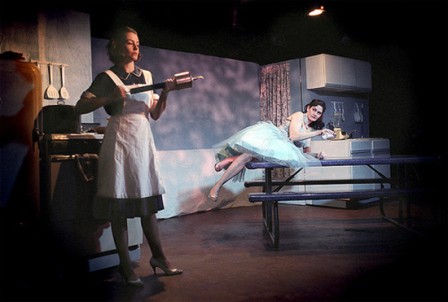
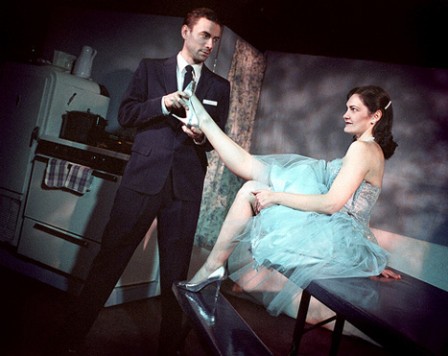
Keeping the audience on its feet for the play’s entire 80 minutes, Graney walks us through a set that continues to unfold as a maze while the action plays out directly in front of us. We start in the kitchen, where downstairs servants and betrothed lovers Jean (Hardigan) and Christine (a nicely starchy Gleisten) are cleaning up after a party. Bored daughter of the estate Miss Julie barges in on them, dressed like a debutante sex kitten from an Elvis musical, and demands Jean’s attention. (She can have it, of course; her competition is just the maid.) By dawn, degenerate “half-woman” Julie has carried on sexually like any man would (lovely Stoltz, who like all the lovely Hypocrite women, has spent much of her career playing against her femininity, finds the strength where woman-hating Strindberg only wrote perversion). As they frolic and spar, Graney has us traipse with them through a basement barroom, an apocalyptic junkyard and an abattoir.
But unlike the 11th-hour face slaps Graney has tried in the past, here the descent into squalor and weirdness is easeful, even gentle. And for all the rigidity in the performances (maybe because of it?), the play is very much visceral and alive. You won’t soon forget the postcoital pillow talk murmured on walkie-talkies, the hard snap of Stoltz’s finger when Hardigan breaks it to subjugate her or, best of all, sinewy Hardigan’s harrowing rock solo—pure post-punk opera—in which a proletariat joe lets out a jolting primal scream.
The Hypocrites have succeeded so often through lack of competition, which is a bummer both for us and for them. If there were more theater this subversive in Chicago, the company would have both peers and rivals; each fosters quality in a different way. In the meantime, we have a weird quandary: a Miss Julie that should be seen by as many people as possible, playing in a tiny room that could hardly accommodate everyone who would appreciate it; produced at a moment when the play is relevant again but in a style that has little to do with the world around it.
Humanity, and American humanity in particular, once again faces the kind of epochal change that inspired the play to be written in the first place, although almost none of that change is represented here. As what Strindberg would consider a “half-woman” vies for control of the free world, as non-European immigrants reestablish visible castes in a society that once foolishly billed itself as classless and as corporations (our “upstairs” masters) accumulate more power than governments and more personality than private citizens, as well, Miss Julie may be legitimately back in style.
The playwright, like this production, was on to so many things no one else could see. That’s only disturbing when you also consider all the things he didn’t” – Chris Piatt, TimeOut Chicago 1/25/08
The Hypocrites aggressive, arresting revival of “Miss Julie” opens with a musical riff paraphrasing August Strindberg’s call for a new type of naturalist theater: unsentimental and unflinchingly real. “This is not a revolution, just a little change,” sings the trio. “Let’s do something new.” In Sean Graney, a determinedly innovative director, Strindberg has an ideal interpreter for his ground-breaking but problematic tragedy whose reputation as a harbinger of a new style outweighs its dramatic power. It centers on the class and gender war between the privileged, troubled Miss Julie (a nicely contradictory Stacy Stoltz as the failed rebel), and her father’s valet Jean (Gregory Hardigan, more sympathetic than sadistic) who loathes the upper class yet longs to be part of it. “Miss Julie” plays out in the shifting power balance between the unlikely lovers who flirt, seduce, humiliate, confess and reject each other over the course of a midsummer night, during which they’re occasionally joined by Samantha Gleisten’s cook, Kristin, who embraces her lower-class status. The actors nicely shaded performances hint at something simmering below the surface. When it erupts — as in the dramatic scene midway through the play where Graney strips his characters and leaves them mired in the wreckage of their lives — it results in one of the most satisfying moments in the production.
Like last year’s “Mud,” “Miss Julie” is staged promenade style, meaning the audience walks around Marcus Stephens’ set. A giant crate that opens to reveal the various places on Miss Julie’s family estate where her and Jean’s ill-fated affair unfolds, the set is an inspired representation of how class and gender box in these characters” – Barbara Vitello, Daily Herald 1/25/08Highly Recommended – Chicago Reader – “Like most audiences at promenade productions, the one shepherded through the Hypocrites’ deconstruction of August Strindberg’s one-act turned into a self-conscious clump, blocking one another’s sight lines and yearning for invisibility. But imagining close-up spectators may have encouraged director Sean Graney to push his actors toward the understated, multilayered performances that give caustic immediacy to much of this potentially melodramatic showdown between a neurotic aristocrat and her opportunistic servant. Gleefully obliterating Strindberg’s naturalism, the production’s garish sets, original pop songs, and unrelenting jumbled anachronisms provide illuminating aesthetic collisions with the text for the first half of this 70-minute show. But as the evening wears on, the conceptual clutter piles up: roller blades, walkie-talkies, flashlights, and sides of beef obscure the underlying human story” – Justin Hayford, Chicago Reader 1/24/08
5 Shows to See Now – NewCity – August Strindberg’s late-nineteenth century examination of class wars and sexual politics ha sbeen given an electrified working over by The Hypocrites, in a new adaptation from Sean Graney, who also directs. Graney continues his exploration of the promenade-style seen in other recent productions from the company, practically daring the audience to get face to face with the action – not to mention the spit, the sweat and the (fake) blood- as flirtation between the impetuous lady of the house, Mis Julie Stacy Stoltz) and Jean (Gregory Hardigan), the estate’s charmingly punctilious valet, spirals into debauchery. The cast – which includes Samantha Gleisten as Kristin, the cook (and Jean’s betrothed) – is magnificient, imbuing each moment with skillfully nuanced urgency and danger that turns on a dime from ambiguously veiled to desperately immediate. While the ambitious manuever of keeping the audience on their feet, invited to move at will around and through Marcus Stevens’ undeniably artful set – full of crafty reveals – gives an exciting perspective to the viewer, at times it creates a (perhaps superfluous) barrier as well. What in theory could be a shoulder-to-shoulder audience love fest in reality demands strategic positioning (or uncomfortable craning) to ensure one doesn’t miss a moment of this explosive and thrilling production”. – Valerie Jean Johnson – NewCity 1/24/08
“The Hypocrites are to modern theater what Martha Graham was to dance and The Replacements were to rock and roll—truly original. Even when their present production of August Strindberg’s “Miss Julie” reaches confounding levels of show-off wizardry that seemingly have nothing to do the script, they are still fascinating to behold.
Director and adaptor Sean Graney’s production emphasizes the lead characters’ fears of committing to a particular dream, but he does not suffer from the same fate himself. Graney fully realizes a mobile, revolutionary theatrical experience, finding new meaning in what many consider a difficult though often-produced text. His elaborate touches signify greatly in a world where the very poor and the very privileged still exist side by side with an uneasy truce.The audience for “Miss Julie” wanders from set piece to set piece, rarely sitting, as its classical story unfolds. It is All Summers Eve and the household run by Miss Julie and her well-off father is celebrating. With her father away on business, the recently rejected Miss Julie takes the opportunity to toy with her male employees by drinking and dancing with them. Miss Julie eventually sets her sights on her father’s masculine boot man, Jean. Though Jean is promised to the no-nonsense household cook, Kristin, he allows himself to become engaged in a twisted all-night, power-hungry rendezvous with Miss Julie. When the dust (and many flung props) settles, Miss Julie and Jean must decide to stay and face the music or flee toward a life of dreamy possibilities. Of course, before all is said and done, as the recently Oscar-nominated movie proclaims, there will be blood.
Working on Marcus Stephens’ mind-boggling creative set, which includes a working kitchen, a slaughterhouse and an employee break room, Graney’s cast performs with all-out fervor. They emphasize both the passion and the humor in this war of the classes and fill the air with an essence of macabre sexuality and stunted grace. Stacy Stoltz gives her Miss Julie a clipped control that steadily decreases as the evening progresses. As she lies, disgraced and exhausted, wrapped around a carcass of beef in the show’s final moments, she actually seems to dissolve, dejectedly, into the prop.
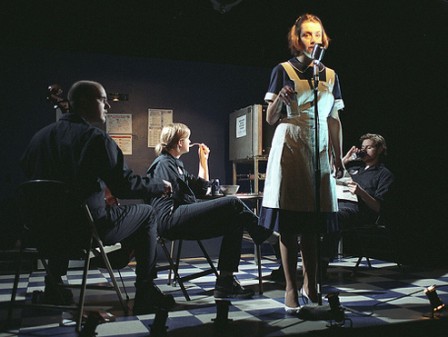
Gregory Hardigan allows his Jean both a comical scorn and a poetic strength. He captures the ultimate lust and regret of his character, providing one of the most accomplished performances of the current theater season. As Kristin, Samantha Gliesten glistens with righteousness and strength. Fully inhabiting Allison Siple’s multifaceted costumes, Gliesten provides ultimate grace in the face of torment. The production is also ably supported by the perky vocal harmonies of Ryan Bourque and Lila Collins as the farm workers. All are skillfully framed by Jack Tamburri’s passionate fingerings on the cello.
While many of Graney’s colorful nuances make artistic sense, a post-coital scene between Julie and Juan, featuring an exploding wall of props including roller blades and walkie talkies, seems to represent nothing but bizarreness for its own sake. Still, Graney’s work here is nothing but provocative, providing audiences with a thrilling and totally alive theatrical experience. Inventive art can justify even the most common existence and the Hypocrites’ “Miss Julie” ultimately provides that fulfillment in spades”. – Brian Kirst, Chicago Free Press 01/2008“Sean Graney is among Chicago’s most talented, creative and, best of all, audacious young directors. Much of his recent work for his company, The Hypocrites, has exploded and thus greatly illuminated several iconic period dramas. The Hypocrites’ version of August Strindberg’s “Miss Julie” is just not one of those shows. This one fights the play.
I’m not arguing that this throbbing, naturalistic drama from 1888 about a social-climbing valet and an upscale mistress titillated by the possibility of social demise demands a realistic production. On the contrary, the best “Miss Julie” I ever saw was a brilliantly acted Anne Bogart version in Louisville that set the whole shooting match inside a wrestling ring.
Graney goes even further with his concept. You don’t get to sit down but instead are led around an open space in the basement studio of the Chopin Theatre, where you discover a plethora of settings, ranging from a contemporary break room (where “farmhands” play a game of Risk) to the infamous kitchen to an abattoir where Miss Julie’s demise takes place amid swinging carcasses of meat, akin to the aging room of an upscale steakhouse.
The Hypocrites often thrives in environmental setups, and Marcus Stephens’ highly creative scenic design certainly conveys a post-apocalyptic fervor. But the price that gets paid — and it ain’t worth it — is that nothing gets to build. By defusing the text in this fashion, the work becomes a series of flat episodes rather than the ever-building, ever-tenser drama that Strindbergian naturalism surely demands.
More problematic, the production doesn’t root the show in its essential themes of class. Miscast as Miss Julie, Stacy Stoltz reads as similar social status to Gregory Hardigan’s Jean. And despite explicit sexual episodes, the couple don’t radiate much heat. The scenes between the hard-working Hardigan and Samantha Gleisten’s more intense Kristin are much, much better, but then the show isn’t called “Miss Kristin.” – Chris Jones, Chicago Tribune 1/26/08
Artistic Director Sean Graney returns to promenade performances with August Strindberg’s classic tale of struggle between the sexes. A young woman faces the conflicts between the class of her father and that of her mother one evening as the spring turns to summer. In this stinging analysis of class society, the pretense of inherent psychological differences is stripped away to reveal a brutally honest portrayal of man. As the evening progresses, it turns out that the only difference is that one class has had a life with no real experiences and the other has had a life filled with work and little time to dream.
Director
Sean GraneyPerformers
Ryan Bourque, Lila Collins, Samantha Gleisten, Gregory Hardigan, Stacy Stoltz, Jack Tamburri