

Richard II:Poet King
Gilead Productions
“?The rise of such theater companies as Lookingglass has caused young local performers to rethink their craft and open themselves up to a more European style of performance and conception. One of the best of the new troupes in this stream of influence is Gilead Theatre Company. “ Andrew Patner, Chicago Sun Times

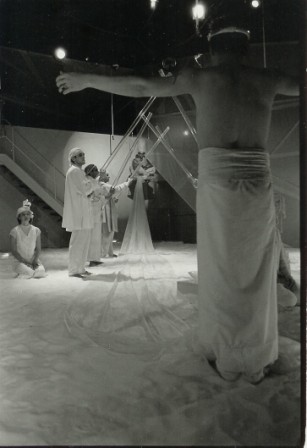
?Arrogant and sybaritic, Richard II nevertheless moved England from disorder to prosperity in 22 years, then lost the throne through power plays and hubris. Six hundred years after his death, Chicago theater has been giving the monarch his dramatic due: his death haunts Henry IV, recently presented by Shakespeare Repertory, while he himself appears, complete with queen and lover, in Famous Door Theatre’s Two Planks and a Passion. Now Gilead’s poetic, visually stunning production offers a sympathetic take on the hapless Plantagenet. Created by the ensemble and powerfully staged by Arkansas director Brad Mooy, this 90-minute adaptation creates a complex king out of Elizabethan sources, including Shakespeare and Raphael Holinshed’s history of England. Concentrating on the last two years of a tempestuous reign, Gilead’s staging enacts the dynastic war between “killing cousins” Richard and Bolingbroke, which ends with Richard’s murder.
Like Thirteenth Tribe’s recent Blood Line, this is exciting communal art–classic Chicago theater. The disciplined, athletic 13-member cast includes two Richards (Kevin Stark and Michael Gotch, in remarkably well coordinated recitations) to suggest the divided king, as well as five Isabels and five Bolingbrokes to convey the diverse reactions of his queen and usurper. Stephanie Nelson’s bleached set of white sand, billowing curtains, and dripping ice sculptures is complemented by Ann Boyd’s blanched costumes and energized by Michael La Tour’s dynamic sound design and Andrew Meyers’s gorgeous lighting.? Lawrence Bommer, Chicago Reader May 14, 1999
?Director Mark-John McSheehy has his rebellious prelates and barons skulking in the shadows behind the four huge columns of the Chopin Theatre’s open stage; and, to emphasize the play’s metaphor of the wheel of fortune, from which the characters “tumble headlong down,” he has placed Edward’s throne at the tip of an axis that grinds forward at key plot points and finally comes full circle at play’s end. McSheehy also has paid more attention to developing the character of Edward’s wife, Queen Isabelle, and her paramour, the rebel Roger Mortimer. As the queen, Melissa Carlson convincingly turns from forlorn reject to vengeful harpy; and Christian Kohn at least hints at the transformation of Mortimer from high-minded leader to overbearing tyrant.” Chicago Tribune
?The rise of such theater companies as Lookingglass has caused young local performers to rethink their craft and open themselves up to a more European style of performance and conception.
One of the best of the new troupes in this stream of influence is Gilead Theatre Company. Starting out two years ago with a production of Lanford Wilson?s ?Balm in Gilead,? a play much more identified with those pioneers of kitchen-sink realism over at Steppenwolf, it followed that show with a well-received revival of Martin Sherman?s ?Bent?Now the company is premiering a work that it has co-authored as much as interpreted, ?Richard II, Poet King.? Beginning with Shakespeare?s history play on the troubled young king, director Brad Mooy has drawn on Holinshed, Samuel Daniel and other chroniclers of England?s Wars of the Roses to shape his story.
More important, Mooy has worked with the actors in the company and with four extremely talented designers to create what is something of a giant poem obout life and death, power and politics, vanity and truth.
Making full use of the large open space of the Chopin Theatre, designer Stephanie Nelson and costumer Ann boyd shape a giant white world that can serve as both exterior and inner exile, blissful dreamscape or harsh landscape. Cast members begin the 90-minute piece by hanging a set of icy blocks from the roof. As the play progresses, the blocks are revealed-as they melt under the fluid lighting of Andrew Meyers ? to be frozen roses.
Mooy engages in some exquisite doubling of parts. The brunet Todd Frampton and the blond Michael Gotch simultaneously play Richard, alternating his extroversion and selfish petulance. Moving in their own right, they also supply as good an acting out of this severely conflicted character as you are likely to see.
Richard?s second queen, Isabella of Spain, is played at first by five then four, then three and finally by one actress in a progression toward wholeness that?s juxtaposed against Richard?s permanent fracture.
Shakespeare?s poetry is ever-present ? how could it not be in the play that proposes that we ?sit and tell sad stories of the death of kings?? But other kinds of poetry ? physical as well as verbal ? and, in Michael LaTour?s sound design, musical, too, are always present. Every one of the cast of 13 moves in rhythm with his production. A handout supplies the relevant plot details; the players offer the heartbreak.? Andrew Patner, Chicago Sun-Times June 18, 1999
Director
Brad MooyPerformers
Wendy Carter, Phil Donlon, Jessica Dunton, Kate Garassino Frampton, Todd Frampton, Michael Gotch, Anish Jethmalani, Michael Kingston, Vincent Lonergan, Shawn Rogers, Vanessa Stalling, Kevin Stark, Jamie Virostko